

Dynamic Line Rating still not widely used in Europe, according to a new assessment by CurrENT Europe
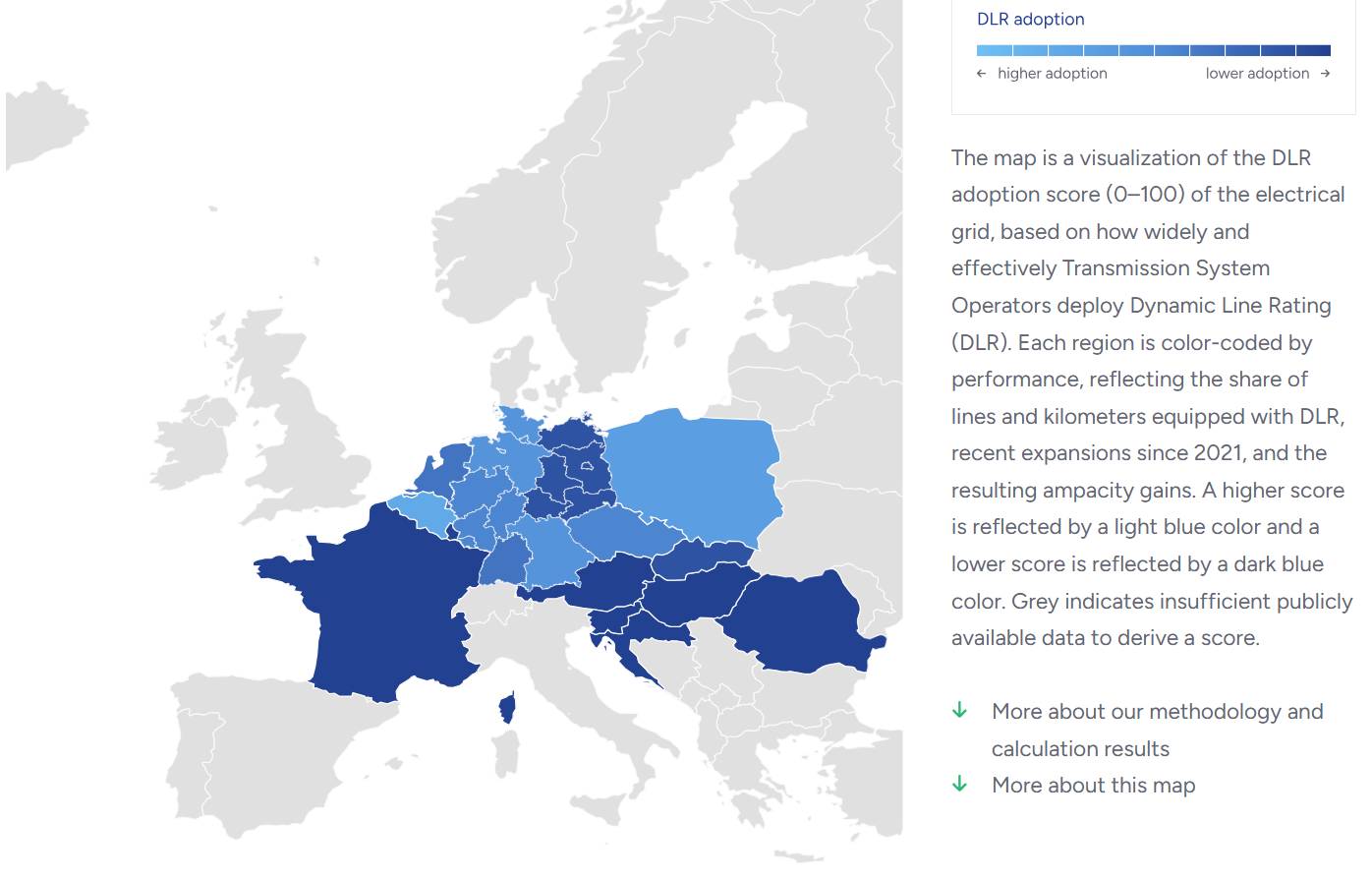
According to a new assessment that looks at publicly available data, there is very little evidence that Dynamic Line Rating (DLR) is being systematically used by grid operators in Europe. While it is widely recognized as a technology that can help make the most out of the existing grid – including by the Grids Package proposed by the European Commission last week – it is for the most part impossible to determine whether it is actually being used in day-to-day operations.
This assessment comes at a crucial time, as the recently published Grids Package proposal highlights the role that innovative grid technologies like Dynamic Line Rating can have in making the most out of the existing electricity grid. Monitoring the adoption of DLR across Europe, as well as other innovative grid technologies, will be key to supporting the implementation of this new package.
In line with the ambitions of the Grids Package to quickly deliver extra grid capacity, delivering additional capacity is exactly what Dynamic Line Rating delivers. Air temperature and wind cooling determine how much electricity can be safely transported through an overhead line at any given moment. With dynamic line rating, grid operators can measure in real time, through sensors and weather data, what the safe capacity is at that moment, and with this knowledge transport much more electricity safely through an overhead line. This means less renewable energy is wasted, and it can significantly reduce costs for consumers.
And yet, looking at publicly available data, it is difficult to determine whether grid operators have installed any Dynamic Line Rating, on how many of their lines, and whether they are actually using it. Using the JAO data set, the best data set available, we must conclude that many grid operators are either not using DLR at all, or not including it in the data they provide to the JAO data set. However, this is a missed opportunity, as this means the extra capacity that Dynamic Line Rating can provide is not being used by the market.
To showcase this, CurrENT has come up with a scoring system of 0-100, based on different factors such as whether a TSO has equipped any lines DLR, whether it has equipped cross-border lines with DLR, the share of lines it has equipped with DLR etc. Some countries like Belgium and Poland are really good performers. On the other hand, a large amount of countries score 0 out of 100.
This map is a tool to monitor and promote the use of DLR and an opportunity for TSOs to increase their transparency of existing DLR use. CurrENT wants to invite everyone to use this map, and invite TSOs to openly share how they are using DLR, and saving costs for European consumers.
