

MEPs support the prioritisation of non-wire solutions in today’s TEN-E vote
Brussels, 10 September 2026 – In today’s ITRE vote, MEPs are supporting the priority consideration of non-wire solutions in network planning, as well as a clear overarching definition of Grid Enhancing Technologies including both innovative wire and non-wire solutions. This stands in sharp contrast to the Council’s General Approach, which removed the priority consideration of non-wire solutions, (General Approach, TEN-E & Permitting directive).
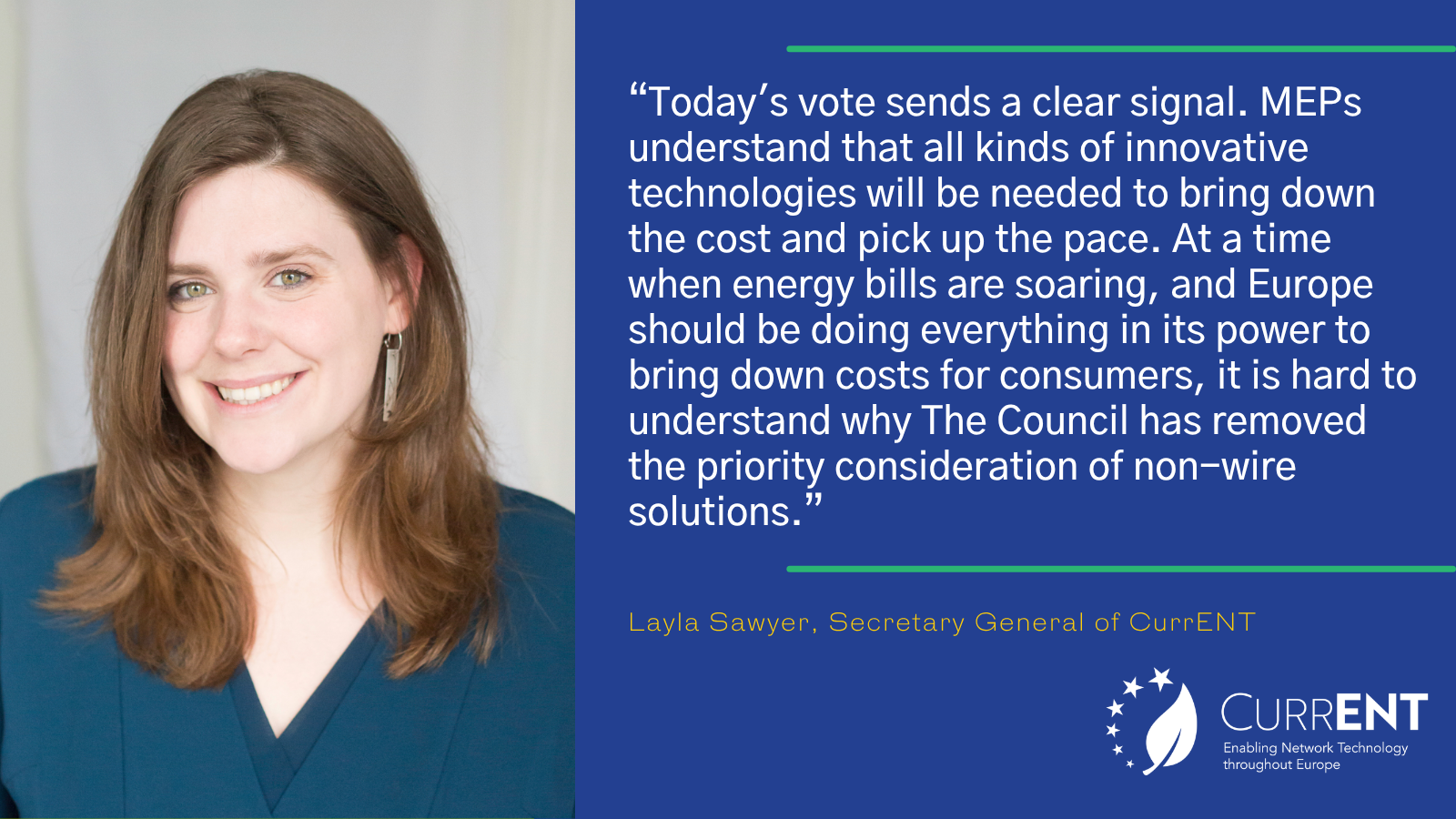
“Today’s vote sends a clear signal. MEPs understand that all kinds of innovative technologies will be needed to bring down the cost and pick up the pace,” according to Layla Sawyer, Secretary General of CurrENT. “At a time when energy bills are soaring, and Europe should be doing everything in its power to bring down costs for consumers, it is hard to understand why The Council has removed the priority consideration of non-wire solutions.”
Electricity grid expansion projects take an average of ten years to complete. Many Grid Enhancing Technologies, including innovative wire and innovative non-wire solutions, can unlock existing capacity within months and at a fraction of the cost. Prioritising them does not mean delaying grid expansion: new lines and cables remain indispensable and must be built as quickly as possible. Instead, Grid Enhancing Technologies can unlock additional capacity earlier while conventional infrastructure is planned, permitted and built. CurrENT estimates that systematic deployment could save Europe up to €700 billion in conventional expansion costs by 2040.
By keeping this prioritisation (Article 29 TEN-E; revision Article 2 Permitting directive) and adding the right definition in the text (Article 2 (19)), the Committee has matched the pace of grid capacity to the pace of renewables coming online. Renewable capacity is being delivered much faster than conventional grid infrastructure can be built. Without the full toolkit of Grid Enhancing Technologies, that mismatch will only widen, putting the mass uptake of renewables and the EU’s climate and energy targets at risk.
Today’s vote builds on the position Parliament already took in its June 2025 resolution on its own initiative report on electricity grids, and stands in sharp contrast to the Council’s general approach, agreed in June, which removed this prioritisation altogether. With the European Council having called for co-legislators to reach agreement on an ambitious Grids Package within 2026, CurrENT urges the Council to restore this provision in the final text, so that Europe’s grid planning delivers capacity as quickly and cost-efficiently as possible.
